
Exploring the mechanisms enhancing biodiversity
Anthropogenic activity threatens biodiversity through climate change, habitat fragmentation, and increasing frequency and scale of disturbance. Metacommunity models have proved valuable to understand how such disturbances shape community structure and species coexistence (biodiversity). In this context, I develop agent-based simulations and mathematical models combining several biodiversity theories to better understand how the effects of anthropogenic disturbances on biodiversity. The final goal is to develop a predictive theoretical framework that can help inform biodiversity management decisions with consequences for species conservation.
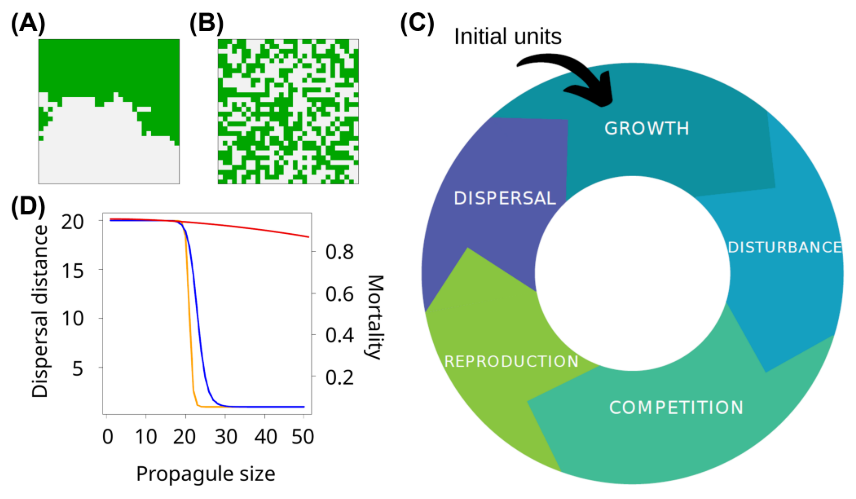
Figure 1. (A) Example of Aggregated landscape, where green and gray patches represent high and low quality patches, respectively; (B) example of Random landscape. (C) Flow diagram of the model. Units (simulated organisms) are introduced in the simulation; units grow; a stochastic extinction probability is applied to each patch; in occupied patches, competition leads to extinction of all but one unit; if their size is higher than their investment threshold, they reproduce (if not, they remain in the patch waiting for the growth phase); when units reproduce, their offspring can be mutants regarding investment and/or propagule size; propagules disperse and land on occupied or empty patches. (D) Curves for the dispersal distance with strong (yellow) and weak (red) size–dispersal tradeoff, and dispersal mortality (blue) as a function of propagule size.
Image from Planas-Sitjà et al. 2023 (Oikos) - Agent-based simulations to understand how environment shapes the evolution of reproductive strategies when considering co-evolution of traits.